



Can the LED Machine Status Light be used in nuclear power plants?
Nov 27, 2026
Leave a message
If you’ve ever walked through a manufacturing plant—especially one with heavy machinery, precision equipment, or high-stakes operations—you’ve probably glanced up and seen a row of colored lights glowing to signal a machine’s status. These small, unassuming devices are called machine status lights, and they’re the unsung heroes of industrial operations: a quick visual cue that tells workers if a process is running smoothly, needs attention, or has stopped entirely. For most factories, warehouses, and assembly lines, these lights are a no-brainer—they’re energy-efficient, durable, and cost-effective. But what if that operation isn’t a typical factory floor? What if it’s a nuclear power plant, where every piece of equipment must meet the strictest safety and performance standards on Earth? As an LED machine status light supplier who’s spent years refining products for harsh industrial environments, I get asked this question all the time: Can the LED machine status light be used in nuclear power plants? The short answer is yes—but only if it meets a specific set of non-negotiable requirements that go far beyond what’s needed for standard machinery.
Let’s start with why nuclear power plants are so different from other industrial sites. When you’re generating electricity for millions of people, safety isn’t a priority—it’s the foundation of every design, component, and process. Nuclear plants operate in environments with extreme temperature fluctuations, high levels of radiation, tight space constraints, and strict regulatory rules set by organizations like the U.S. Nuclear Regulatory Commission (NRC) and the International Atomic Energy Agency (IAEA). Every part of the plant, from a pipe valve to a status light, must be able to perform its job reliably even when conditions are less than ideal. A single malfunctioning part in a nuclear plant isn’t just an inconvenience—it can lead to costly shutdowns, safety risks, or even regulatory scrutiny. That’s why traditional status lights (incandescent or even standard LEDs) are often ruled out before they ever make it through the approval process.
So what do nuclear power plants need from a status light? First and foremost, radiation resistance. LED lights use semiconductor technology, which is inherently more resistant to radiation than the filament in an incandescent bulb—but not all LEDs are created equal. Low-quality LEDs, even those marketed for industrial use, can degrade rapidly when exposed to the gamma and neutron radiation present in nuclear plant areas like control rooms, turbine buildings, and auxiliary systems. Over time, this degradation would dim the lights, change their color, or cause them to fail entirely—creating confusion for workers who rely on them to make split-second decisions. A good machine LED warning light designed for nuclear service uses radiation-hardened semiconductors, encased in materials that don’t break down under constant radiation exposure, and undergoes rigorous testing to prove it can perform for decades without losing brightness. That’s a level of testing most standard LED lights never see.
Next comes durability. Nuclear plants are not gentle on equipment. Temperatures can swing from near-freezing in outdoor turbine halls to scorching inside reactor containment structures. Humidity levels are often extremely high, and dust, corrosive chemicals, and vibration from heavy machinery are constant factors. A status light that works fine in a climate-controlled factory might crack, short circuit, or stop working within months in a nuclear plant. For this reason, nuclear-grade status lights must be rated for extreme temperatures (usually -40°C to 85°C or higher), have sealed enclosures that meet IP67 or IP69 standards to keep out water and dust, and be built to withstand years of continuous vibration. That’s why many nuclear plants opt for modular designs, like the Led Stack Light—an option that lets operators change individual color modules or bulbs without replacing the entire unit. That not only saves on maintenance costs but also reduces the number of times workers have to enter potentially high-radiation areas to make repairs, which is a huge safety plus.
Another critical factor is visibility. In a nuclear plant, workers can’t be staring at digital screens all day—sometimes they need to glance up from a maintenance task or across a large room and immediately know a machine’s status. Standard LED lights might be bright enough for a small factory, but in a large, high-bay plant with lots of glare from overhead lights, their brightness can be impossible to see. Nuclear-grade status lights need to deliver high-luminance output that cuts through glare, while also being energy-efficient enough to run 24/7 without spiking the plant’s electricity costs. Color accuracy is also key—if a red light is actually orange because of degraded LEDs, workers might mistake a “stop” signal for a “slow down” signal, leading to dangerous mistakes. That’s why the best status lights for nuclear use use color-corrected diodes that maintain their hue for years, even in harsh conditions.
Now, let’s talk about regulation and compliance. Nuclear plants are some of the most heavily regulated facilities in the world, and every component must meet specific standards to be approved for use. The NRC, for example, requires that all safety-related equipment undergo “qualification testing” to prove it can withstand the plant’s operating conditions for its entire service life. This means a status light can’t just be tested in a lab—it has to be installed in a mock nuclear environment and exposed to radiation, temperature swings, and vibration to ensure it performs as expected. Many standard LED lights don’t have the certifications required for nuclear use, so suppliers have to work closely with plant engineers and regulators to make sure every part of the light—from the circuit board to the wiring—meets strict guidelines. That’s one area where my team has focused a lot of our work over the past decade: we don’t just sell lights—we collaborate with nuclear plant teams to customize solutions that fit their exact needs, from Wall-mounted Signal Lights for tight control room spaces to compact Equipment Indicator Lights for small, hard-to-reach machinery.
But wait—does that mean every LED machine status light is a good fit for nuclear plants? No way. There are plenty of lights on the market that say they’re “industrial grade” but don’t meet nuclear standards. For example, a standard machine LED warning light might have a plastic enclosure that cracks under high radiation, or its LEDs might fade in just a few years, leaving workers in the dark. That’s why it’s so important to work with a supplier that understands both LED technology and the unique demands of nuclear power. We’ve seen too many plants learn this the hard way: they buy cheap lights to cut costs, only to have to replace them every few years, spending more in the long run and putting workers at risk in the process.
There are also specific use cases where LED status lights make even more sense in nuclear plants. For example, in control rooms, workers need lights that are low-glare to avoid eye strain during long shifts. LEDs are naturally low-glare when designed correctly, making them better than incandescent lights for this application. In outdoor areas, LEDs use a fraction of the energy of incandescent lights, reducing the plant’s overall carbon footprint—something that’s increasingly important as the energy industry works to be more sustainable. Even in emergency situations, LED lights react faster than incandescent lights: they turn on instantly, which is critical if a reactor needs to be shut down quickly and workers need clear status signals right away.

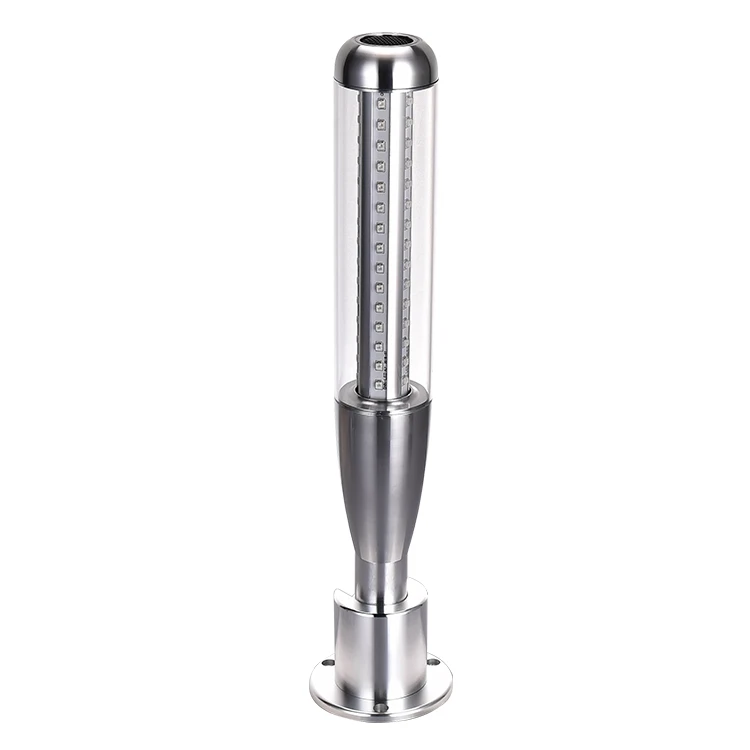
Of course, no technology is perfect, and LED status lights do have limitations when it comes to nuclear use. For one, they are electronic devices, which means they have components that can fail—though nuclear-grade LEDs are designed to minimize this risk. They also require a reliable power supply, which is a non-negotiable in any critical facility. That’s why many nuclear plants pair LED status lights with backup power systems, so if the main grid goes down, the lights still work. Another consideration is disposal: LEDs contain small amounts of lead and other materials, so at the end of their long service life (which is usually 10–15 years for nuclear-grade lights), they need to be disposed of properly, following nuclear waste regulations. This is a small detail, but it’s one that responsible suppliers plan for, offering take-back programs for old lights to make the process easier for plant teams.
From my experience working with dozens of nuclear plants across North America and Europe, the biggest barrier to using LED status lights isn’t the technology itself—it’s the perception that they can’t meet nuclear standards. When I first started talking to plant engineers about LEDs for status lighting, many were skeptical. They had worked with incandescent lights for decades and assumed LEDs wouldn’t hold up. But after testing our nuclear-grade Led Stack Light in their facilities, the skepticism turned to enthusiasm. One plant in the Midwest recently replaced all their incandescent status lights with our LED lights, and they reported a 70% reduction in maintenance costs because they no longer had to replace burned-out bulbs every six months. They also noted that workers found the lights easier to see, leading to fewer mistakes and safer operations.
So, to circle back to the original question: Can the LED machine status light be used in nuclear power plants? The answer is a resounding yes—but only if it’s specifically designed, tested, and certified for nuclear service. It’s not a one-size-fits-all solution; it requires a supplier that understands both the technology and the regulatory landscape, and a plant that’s willing to invest in quality to ensure long-term safety and reliability. For plants that make that investment, LED status lights offer clear benefits: lower energy costs, less maintenance, better visibility, and a longer service life than traditional incandescent lights.
If you’re part of a nuclear power plant team looking to upgrade your status lighting, or if you want to learn more about nuclear-grade LED solutions, I encourage you to reach out. My team has been working with industrial and nuclear facilities for years, and we can help you find the right status light for your specific needs—whether that’s a compact Equipment Indicator Light for auxiliary machinery, a high-brightness LED Signal Tower Light for large turbine halls, or a durable Wall-mounted Signal Light for control rooms. Don’t settle for lights that might work in a standard factory; for nuclear operations, you need a solution you can trust, and we’re here to help make that happen.
References
International Atomic Energy Agency. (2021). Nuclear Power Plant Safety Standards: Components and Systems. IAEA Safety Standards Series.
U.S. Nuclear Regulatory Commission. (2022). Qualification of Electrical and Instrumentation Equipment for Nuclear Power Plants. NRC Regulatory Guide 1.20.
Nuclear Energy Institute. (2023). Advanced Lighting Technologies for Nuclear Facilities. NEI Technical Report.
IEEE. (2020). Radiation Effects on Semiconductor Devices for Nuclear Environments. IEEE Transactions on Nuclear Science, Vol. 67, No. 6.
Send Inquiry